Showing posts with label geometry. Show all posts

Sunday, 14 February 2016

Billy the Bug and Graph Mole are Hungry

Hello Grade 7 or anyone else that struggles with plotting, reading or writing coordinates.

Use a game to learn how to do this. No worksheets required!
Learn through the game and mistakes along the way. Feed Billy, he's hungry...

Billy the Bug - right here!


Graph Mole has extension activities - negative indices and also decimals. You start with positive integers.


Thursday, 19 March 2015

Spirograph! One of the things I loved the most as a kid

Whenever I am in vintage or second hand shops I always look for Spirograph. I could twirl the things for ages making amazing designs.

It's now online! I would prefer the set, but this is amazing.

Make something beautiful and upload it to the gallery.

Better yet investigate the mathematics in those designs.

CHECK IT OUT HERE


Sunday, 14 December 2014

Maths and you guessed it... Christmas


Here is a gift for you from Mathsland - a game. It's the latest thing and Jo Boaler of Stanford likes it so much she is now on the team..

Download Mathbreakers and puzzle it out. It looks like Mathbreakers will just keep growing too.

And this ancient game - I haven't beaten the computer yet. Can you? Cool Math - Mancala

For the next game you will need a 10 by 10 grid - this is called How Close to 100? To make it more challenging try How Close to 1 and use decimals. This is from Jo Boaler.

You will need
• two players
• two dice
• recording sheet


This game is played in partners. Two children share a blank 100 grid. The first partner rolls two number dice.
The numbers that come up are the numbers the child uses to make an array on the 100 grid. They can put the array anywhere on the grid, but the goal is to fill up the grid to get it as full as possible. After the player draws the array on the grid, she writes in the number sentence that describes the grid. The second player then rolls the dice, draws the number grid and records their number sentence. The game ends when both players have rolled the dice and cannot put any more arrays on the grid. How close to 100 can you get?
Variation Each child can have their own number grid. Play moves forward to see who can get closest to 100. 


Monday, 13 October 2014

pi 10 Trillion of its Digits - actually only 4 Million of them...

It took 371 days of computing TEN TRILLION decimal places of pi.
Doesn't sound impressive - that requires 44 TB of disk to find them and 7.6 TB to store them, when compressed.

In 1949 the ENIAC computer took 70 hours to calculate pi to 2037 digits.

Check out the Beautiful visualisation and effort in this very cool site and more on how long it would take humans to say all of these digits.

http://two-n.com/pi/


Why do we care? Because this number is everywhere, because it has no pattern, because they say inside these digits are all of our phone numbers, birth dates and every possible combination you could think of. BECAUSE humans and other animals need patterns to understand the world around them. pi is a beautiful mystery and mathematicians like you love puzzles.


"An average person can read out approximately 120 digits ..." 2012. 13 Oct. 2014 <http://www.two-n.com/pi/>

Wednesday, 8 October 2014

Rays of Light and The Lunar Eclipse TODAY

Wednesday Evening's Rare 'Impossible' Lunar Eclipse

Check out the Blood Moon this evening. Hopefully the clouds won't cover it. 


Here is a clip from NASA

Watch in more detail here from NASA. 

Tuesday, 7 October 2014

Nobel Prize goes to THE HEXAGON (and some persistent scientists)


"Neuroscience: Brains of Norway : Nature News & Comment." 7 Oct. 2014 <http://www.nature.com/news/neuroscience-brains-of-norway-1.16079>

Edvard and May-Britt Moser have been working together for 30 years. For 28 of those years they have also been married. 

These two scientists embody the learner profiles and show us how persistence, resilience and problem solving can lead to success. Not only that but mistakes along the way helped them to unravel the mystery of how our brains map out our environments. People are now calling it the GPS of our brains.

They have won the Nobel Prize in Physiology or Medicine, with neuroscientist John O’Keefe at University College London (their former supervisor).

There is no Nobel Prize for Maths as we have discussed in class, but the mathematics is everywhere. Here in our brains wonderful hexagons form the way we sense location.

Please read more about it in the Scientific American and in Nature Magazine. Very exciting brain research! 

Friday, 15 August 2014

Maryam Mirzakhani - my new hero

This is a wonderful article about Maryam Mirzakhani, the first female recipient of the Fields Medal. Thanks to Ajarn Krysten for sharing this with me.

She used to think she couldn't do mathematics. Everyone can do mathematics.

Read it here and watch the video.

Interested in non-standard surfaces? Check out this TEDTalk on crocheting a life size coral reef.


Wednesday, 13 August 2014

Welcome Back and BIG NEWS

Stanford professor Maryam Mirzakhani became the first woman to win the prestigious Fields Medal for mathematics.

The Fields Prize has been awarded to a woman for the first time.


"Iranian-born mathematician Maryam Mirzakhani on Wednesday became the first woman to be awarded the Fields Medal, mathematics' equivalent to the Nobel Prize." Please read more in the CBC online here. 

You can also read more in The Guardian - a nice interview piece and The Stanford University press release, where Maryam Mirzakhani is a Professor of Mathematics


Thanks to Ajarn Lana for sharing this with the Mathematics department.


We are all working with Stanford University this year to develop our Mathematics and a growth mindset and you can puzzle over the famous puzzle that ignited her mathematical curiosity.


Add all of the numbers from 1 to 100 with a system that isn't 1+2+3+4 <-- there is a shortcut (:

Sunday, 1 June 2014

Solar Power, Hexagons and a Moose

There has been a video of a moose lighting up a road as it crosses doing the rounds of social media recently. Today I clicked on it  and I was very impressed.  Two plucky people have invented amazing technology - solar panels that can be used as roads, pathways, outdoor areas shaped like hexagons.

If you are in MYP2 or you're a bee you know that the hexagon is part of making this technology strong.

It has won awards - check it out at indiegogo.com and in the video of one of their fans below.
Why isn't their government getting behind something like this? Great question.

I got behind it.


Friday, 7 February 2014

Here Come the MYP2 Coders!

Anda is first off the blocks with his two codes

A cool Spiral and something quite Disco (if you have epilepsy, Disco is not recommended because there is a lot of flashing).

Click on the links to see the fun.

Disco programming was developed initially by Tera, then Nom and then Anda took it on too. Excellent collaboration.

Anda's Spiral at code.org http://learn.code.org/sh/11921722
Do you want to learn to code - check out the  Hour of Code for lots of tutorials.

Stay tuned - next week all of MYP2s first programs will be live on the blog.

Monday, 6 January 2014

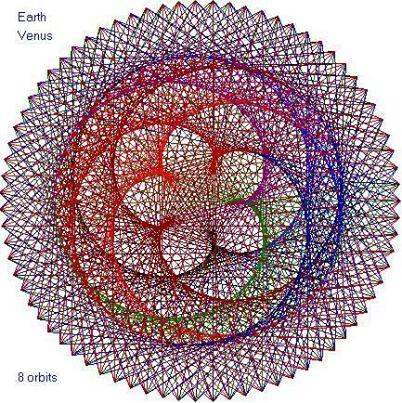
If you track the relative positions of Earth and Venus over an 8 year period, this is the resulting pattern.

from the wonderful sharing world of Twitter

Embedded image permalink

Friday, 15 November 2013

Nature's Shape - is it the HEXAGON?

In MYP2 on Loy Krathong day at school we had another look at nature's shape by watching another cool video from The Code from the BBC.

So many great questions come from this video.

Oh, we also learnt that waveboarders go beyond the normal times tables. Waveboarders know their 180 times tables because of the turns they make/take on their boards.  Very cool!